
MLOps Project for Your Resume on Google Cloud
What you build: an MLOps loop on Google Cloud: quality gate, model registry, batch scoring to BigQuery, drift checks and a retrain that must earn its place. Every step tested.

✍️ Translate this blog into Hindi, Tamil or Telugu
A notebook with 0.9 accuracy is not an MLOps project. An MLOps project shows the loop around the model: a quality gate that decides which model goes to production, a model registry with versions you can roll back to, batch scoring that writes results where the business uses them, drift monitoring that tells you when the world changed, and a retrain that has to earn its place. In this lab you build that loop on Google Cloud for a churn model (which customers will leave?), with Cloud Storage as the registry and BigQuery for the scores, and you watch the gate refuse a bad model.
Who it is for: data scientists, ML engineers and DevOps engineers who want one MLOps project they can explain end to end in an interview. Time: about 1 hour. Cost: a few files in Cloud Storage and a small BigQuery table, inside the free tier.
Every command below was run for real by the CareerByteCode Team, and every output is the real result we got. We typed the commands in a Cloud Shell-like Linux VM (Debian with gcloud, bq and Python 3); Cloud Shell in your browser has the same tools.
Part A: the loop in plain English

- Quality gate: an automatic check before promotion. Ours: the new model's AUC must be at least 0.70 and not worse than production (minus 0.01). AUC (area under the ROC curve) measures how well a model ranks risky customers above safe ones: 0.5 is guessing, 1.0 is perfect.
- Model registry: where approved models live with a version number and metadata. Ours is a Cloud Storage folder per version (
v1/,v2/) plusprod.jsonsaying which one is in production. (Vertex AI Model Registry or MLflow do the same with more features.) - Batch scoring: score every customer once a month and write the results to a table the retention team uses.
- Drift: the input data changes over time. PSI (population stability index) compares a feature's distribution with the training data: below 0.1 nothing, 0.1 to 0.2 watch, above 0.2 act.
- Real-life example: a restaurant's head chef (the gate) tastes every new recipe before it goes on the menu (the registry), keeps the old recipe card in case the new one fails, and changes the menu when the season's ingredients change (drift).
Before you start
A Google Cloud project with billing linked (the free trial works) and Cloud Shell or a small VM with gcloud, bq and Python 3.
Part B: the lab
The pipeline in one file
Each stage is one command. Data is generated (same month = same data), so your numbers match ours. Save it as churn.py:
# churn.py: the whole MLOps loop for a churn model (which customers will leave?), one command per stage.
#   data <month> [--drift]     make that month's customer data (same seed = same data); --drift = prices went up
#   train <month>              train on that month, evaluate on a held-out part, save model + metrics locally
#   gate                       pass only if AUC >= 0.70 and not worse than the model in production
#   promote                    copy the model to the registry in Cloud Storage as the next version, mark it "prod"
#   score <month>              batch scoring: load "prod" from the registry, score every customer, write to BigQuery
#   drift <month>              compare a month's features with the training month (PSI); > 0.2 = act
import json, os, pickle, subprocess, sys
import numpy as np
import pandas as pd
from sklearn.ensemble import GradientBoostingClassifier
from sklearn.metrics import roc_auc_score
from sklearn.model_selection import train_test_split

BUCKET = open(".bucket").read().strip()
FEATURES = ["tenure_months", "monthly_bill", "support_calls", "late_payments"]


def sh(cmd):
    return subprocess.run(cmd, shell=True, capture_output=True, text=True).stdout.strip()


def make_data(month, drift):
    rng = np.random.default_rng(int(month.replace("-", "")))
    n = 8000
    df = pd.DataFrame({"customer_id": [f"C{i:05d}" for i in range(n)],
                       "tenure_months": rng.integers(1, 72, n),
                       "monthly_bill": rng.normal(900 if not drift else 1250, 200, n).round(0),
                       "support_calls": rng.poisson(1.2 if not drift else 2.0, n),
                       "late_payments": rng.poisson(0.4, n)})
    risk = -2.2 - 0.04 * df.tenure_months + 0.002 * (df.monthly_bill - 900) + 0.6 * df.support_calls + 0.8 * df.late_payments
    df["churned"] = (rng.random(n) < 1 / (1 + np.exp(-risk))).astype(int)
    df.to_csv(f"customers_{month}.csv", index=False)
    print(f"customers_{month}.csv: {n} customers, churn rate {100 * df.churned.mean():.1f}%, average bill {df.monthly_bill.mean():.0f}")


def psi(a, b, bins=10):
    edges = np.unique(np.quantile(a, np.linspace(0, 1, bins + 1)))
    pa = np.histogram(a, edges)[0] / len(a) + 1e-6; pb = np.histogram(np.clip(b, edges[0], edges[-1]), edges)[0] / len(b) + 1e-6
    return float(np.sum((pa - pb) * np.log(pa / pb)))


cmd = sys.argv[1]
if cmd == "data":
    make_data(sys.argv[2], "--drift" in sys.argv)
elif cmd == "train":
    df = pd.read_csv(f"customers_{sys.argv[2]}.csv")
    X_tr, X_te, y_tr, y_te = train_test_split(df[FEATURES], df.churned, test_size=0.25, random_state=1, stratify=df.churned)
    model = GradientBoostingClassifier(random_state=1).fit(X_tr, y_tr)
    auc = roc_auc_score(y_te, model.predict_proba(X_te)[:, 1])
    pickle.dump(model, open("model.pkl", "wb"))
    json.dump({"trained_on": sys.argv[2], "auc": round(auc, 4), "rows": len(df)}, open("metrics.json", "w"))
    print(f"trained on {sys.argv[2]}: AUC {auc:.3f} on {len(X_te)} held-out customers")
elif cmd == "gate":
    new = json.load(open("metrics.json"))
    prod = sh(f"gcloud storage cat gs://{BUCKET}/registry/prod.json 2>/dev/null")
    prod_auc = json.loads(prod)["auc"] if prod else 0.0
    ok = new["auc"] >= 0.70 and new["auc"] >= prod_auc - 0.01
    print(f"gate: new AUC {new['auc']:.3f}, production AUC {prod_auc:.3f}, minimum 0.70 -> {'PASS' if ok else 'FAIL'}")
    sys.exit(0 if ok else 1)
elif cmd == "promote":
    versions = [l for l in sh(f"gcloud storage ls gs://{BUCKET}/registry/").splitlines() if "/v" in l]
    v = f"v{len(versions) + 1}"; meta = json.load(open("metrics.json")) | {"version": v}
    json.dump(meta, open("metrics.json", "w"))
    sh(f"gcloud storage cp model.pkl metrics.json gs://{BUCKET}/registry/{v}/ && gcloud storage cp metrics.json gs://{BUCKET}/registry/prod.json")
    print(f"promoted {v} (AUC {meta['auc']:.3f}, trained on {meta['trained_on']}) and marked it prod")
elif cmd == "score":
    meta = json.loads(sh(f"gcloud storage cat gs://{BUCKET}/registry/prod.json"))
    sh(f"gcloud storage cp gs://{BUCKET}/registry/{meta['version']}/model.pkl prod_model.pkl")
    model = pickle.load(open("prod_model.pkl", "rb"))
    df = pd.read_csv(f"customers_{sys.argv[2]}.csv")
    out = pd.DataFrame({"customer_id": df.customer_id, "churn_risk": model.predict_proba(df[FEATURES])[:, 1].round(4),
                        "model_version": meta["version"], "month": sys.argv[2]})
    out.to_csv("scores.csv", index=False)
    sh("bq load --quiet --replace --autodetect --source_format=CSV churn.scores scores.csv")
    print(f"scored {len(out)} customers for {sys.argv[2]} with model {meta['version']}; {int((out.churn_risk > 0.5).sum())} at high risk; written to BigQuery churn.scores")
elif cmd == "drift":
    meta = json.loads(sh(f"gcloud storage cat gs://{BUCKET}/registry/prod.json"))
    base, new = pd.read_csv(f"customers_{meta['trained_on']}.csv"), pd.read_csv(f"customers_{sys.argv[2]}.csv")
    worst = 0.0
    for f in FEATURES:
        p = psi(base[f].values, new[f].values); worst = max(worst, p)
        print(f"  {f:<15} PSI {p:.3f} {'DRIFT' if p > 0.2 else 'ok'}")
    print(f"drift check {sys.argv[2]} vs {meta['trained_on']}: {'RETRAIN' if worst > 0.2 else 'no action'}")
Step 1: the registry bucket and the scores dataset
# The project's Google Cloud parts: a bucket for the model registry and a BigQuery dataset for the scores
python3 -m venv .venv && . .venv/bin/activate && pip install -q "scikit-learn==1.*" "pandas==2.*" 2>&1 | grep -v notice | tail -1; echo "Python packages installed"
echo "mlops-$(echo -n $PROJECT_ID | md5sum | cut -c1-8)" > .bucket
gcloud storage buckets create gs://$(cat .bucket) --location=us-east1 --uniform-bucket-level-access --public-access-prevention > /dev/null && echo "registry bucket created"
bq --location=us-east1 mk --dataset churn > /dev/null && echo "dataset churn created"
Python packages installed
Creating gs://mlops-2c18be0d/...
registry bucket created
dataset churn createdStep 2: month 1: train, gate, promote
Why: nobody copies a model by hand. The gate decides; only then the model is copied to the registry as the next version and marked prod.
# Month 1: data, train, gate, promote. The gate decides; nobody copies a model by hand
. .venv/bin/activate
python3 churn.py data 2026-09 && python3 churn.py train 2026-09 && python3 churn.py gate && python3 churn.py promote
customers_2026-09.csv: 8000 customers, churn rate 11.0%, average bill 900
trained on 2026-09: AUC 0.739 on 2000 held-out customers
gate: new AUC 0.739, production AUC 0.000, minimum 0.70 -> PASS
promoted v1 (AUC 0.739, trained on 2026-09) and marked it prodStep 3: batch scoring to BigQuery
Why: the production model (read from the registry, not from a local file) scores every customer for October, and the results go to churn.scores where analysts and dashboards read them:
# Batch scoring: the production model scores every customer, the results land in BigQuery for the retention team
. .venv/bin/activate; python3 churn.py data 2026-10 && python3 churn.py score 2026-10
bq query --quiet --use_legacy_sql=false --format=pretty "SELECT model_version, COUNT(*) AS customers, ROUND(AVG(churn_risk), 3) AS avg_risk, COUNTIF(churn_risk > 0.5) AS high_risk FROM churn.scores GROUP BY model_version"
customers_2026-10.csv: 8000 customers, churn rate 11.2%, average bill 900
scored 8000 customers for 2026-10 with model v1; 237 at high risk; written to BigQuery churn.scores
+---------------+-----------+----------+-----------+
| model_version | customers | avg_risk | high_risk |
+---------------+-----------+----------+-----------+
| v1 | 8000 | 0.111 | 237 |
+---------------+-----------+----------+-----------+237 of 8,000 customers are high risk this month; the retention team now has a list.
Step 4: monitoring: is October still like September?
# Monitoring: is October's data still like the training data (September)? PSI per feature
. .venv/bin/activate; python3 churn.py drift 2026-10
tenure_months PSI 0.001 ok
monthly_bill PSI 0.004 ok
support_calls PSI 0.001 ok
late_payments PSI 0.000 ok
drift check 2026-10 vs 2026-09: no actionAll PSI values near 0: no drift, no action.

Break it: the world changes
In November prices went up and support got busier. The data drifts; the old model still happily scores it:
# Break it: in November prices went up and support got busier. The data drifts; the old model still scores it
. .venv/bin/activate; python3 churn.py data 2026-11 --drift && python3 churn.py drift 2026-11
customers_2026-11.csv: 8000 customers, churn rate 26.1%, average bill 1251
tenure_months PSI 0.001 ok
monthly_bill PSI 2.639 DRIFT
support_calls PSI 0.408 DRIFT
late_payments PSI 0.000 ok
drift check 2026-11 vs 2026-09: RETRAINmonthly_bill (PSI 2.6) and support_calls (PSI 0.41) moved far beyond 0.2, and churn jumped from 11 percent to 26 percent. The drift check says RETRAIN.
Break it again: a rushed retrain
Under pressure, someone retrains on a tiny slice of November (300 rows) and tries to push it:
# Break it again: a rushed retrain on a tiny, wrong slice (only 300 rows). The gate must refuse it
. .venv/bin/activate; head -301 customers_2026-11.csv > customers_tiny.csv && python3 churn.py train tiny && python3 churn.py gate
trained on tiny: AUC 0.656 on 75 held-out customers
gate: new AUC 0.656, production AUC 0.739, minimum 0.70 -> FAILThe gate refused it: AUC 0.656 is below the 0.70 minimum and worse than production. Without a gate, this model would now be scoring every customer.
Fix it: retrain properly, gate, promote v2
# Fix it: retrain on the full November data, pass the gate, promote v2, re-score. Old versions stay for rollback
. .venv/bin/activate; python3 churn.py train 2026-11 && python3 churn.py gate && python3 churn.py promote && python3 churn.py score 2026-11
gcloud storage ls gs://$(cat .bucket)/registry/ | sed "s#gs://[^/]*/#gs://<bucket>/#"trained on 2026-11: AUC 0.788 on 2000 held-out customers
gate: new AUC 0.788, production AUC 0.739, minimum 0.70 -> PASS
promoted v2 (AUC 0.788, trained on 2026-11) and marked it prod
scored 8000 customers for 2026-11 with model v2; 1320 at high risk; written to BigQuery churn.scores
gs://<bucket>/registry/prod.json
gs://<bucket>/registry/v1/
gs://<bucket>/registry/v2/Trained on the full November data, the new model reaches AUC 0.788, passes the gate, becomes v2 and scores November: 1,320 customers at high risk (churn really did rise). v1 stays in the registry for a one-line rollback (point prod.json back to it).

Step 5: your resume numbers, from the registry and BigQuery
# Your resume numbers, from the registry and BigQuery
for v in v1 v2; do gcloud storage cat gs://$(cat .bucket)/registry/$v/metrics.json; echo; done
bq query --quiet --use_legacy_sql=false --format=csv "SELECT COUNT(*) FROM churn.scores" | tail -1 | sed 's/^/rows in churn.scores now: /'
{"trained_on": "2026-09", "auc": 0.7392, "rows": 8000, "version": "v1"}
{"trained_on": "2026-11", "auc": 0.7879, "rows": 8000, "version": "v2"}
rows in churn.scores now: 8000(The scores table holds the latest month only, because each run replaces it; keep a month partition if you need history.)
Your resume lines (with the numbers you measured)
- Built an end-to-end MLOps loop for a churn model on Google Cloud: versioned model registry in Cloud Storage, monthly batch scoring of 8,000 customers into BigQuery.
- Added an automatic quality gate (AUC at least 0.70, no regression) that blocked a bad retrain (AUC 0.656).
- Added drift monitoring with PSI per feature; detected a price shift (PSI 2.6) and retrained, improving AUC from 0.739 to 0.788.
POC: prove it works
- v1 passed the gate, was promoted and scored 8,000 customers into BigQuery (Steps 2 and 3).
- October showed no drift; November drifted and triggered a retrain (Step 4, Break it).
- The gate refused a tiny retrain and accepted the full one as v2, with v1 kept for rollback (Break it again, Fix it).
Clean up (delete everything)
# Clean up: the dataset and the registry bucket
bq rm -r -f -d churn > /dev/null && echo "dataset deleted"
gcloud storage rm -r gs://$(cat .bucket) --quiet > /dev/null 2>&1; echo "left: $(gcloud storage ls 2>/dev/null | grep -c mlops-) buckets"
dataset deleted
left: 0 buckets
FAQ
Why AUC and not accuracy? With 11 percent churners, a model that says "nobody leaves" is 89 percent accurate and useless. AUC measures ranking, which is what a retention list needs.
Where would this run in production? Each stage as a step in Vertex AI Pipelines or Cloud Composer, on a monthly schedule, with the gate as a pipeline condition. We ran it by hand here.
Why keep v1? Rollback in seconds if v2 misbehaves on real data: point prod back to v1 and re-score.
Is PSI the only drift check? No: also watch prediction drift (the share of high-risk customers) and, when labels arrive, real performance. PSI is the classic first check on inputs.
What is the 0.01 tolerance in the gate? Small AUC differences are noise; the tolerance avoids refusing an equally good model because of randomness.
Troubleshooting
| You see | Why | Fix |
|---|---|---|
| The gate always fails | The minimum is set above what your data allows | Set it from a baseline you measured, as we did (0.70) |
Not found: Dataset churn | The dataset was not created, or in another location | bq --location=us-east1 mk --dataset churn |
| Scores come from an old model | The scorer loaded a local file | Always load the model prod.json points to |
| PSI is huge for every feature | Comparing against the wrong month | Compare with the month the production model was trained on |
| A version folder is missing | The promote step failed after the gate | Check the gate output; re-run promote |
What next
- The basics of the loop: MLOps for Beginners: From Notebook to Production.
- Turn the scores into answers in English: Text-to-SQL: Ask BigQuery Questions in Plain English.
- More hands-on posts: ByteBlog. Practice in ByteLabs and see the courses.
Prepared by the CareerByteCode Team from our tested lab, with AI help for the write-up.
⭐ Keep learning with CareerByteCode
Hand-picked to go deeper on this topicGet CareerByteCode Team's next blog by email
One email a week when they publish. Add the weekly Best of ByteBlog too. No spam, unsubscribe with one click.
We email you once to confirm. By subscribing you agree to the privacy policy.
Related blogs
 CareerByteCode Team
MLflow on Google Cloud: Track Every Experiment
What you build: an MLflow tracking server on Google Cloud with models in Cloud Storage, five tracked runs, a registered champion and the missing-URI mistake. Every step tested.
#ci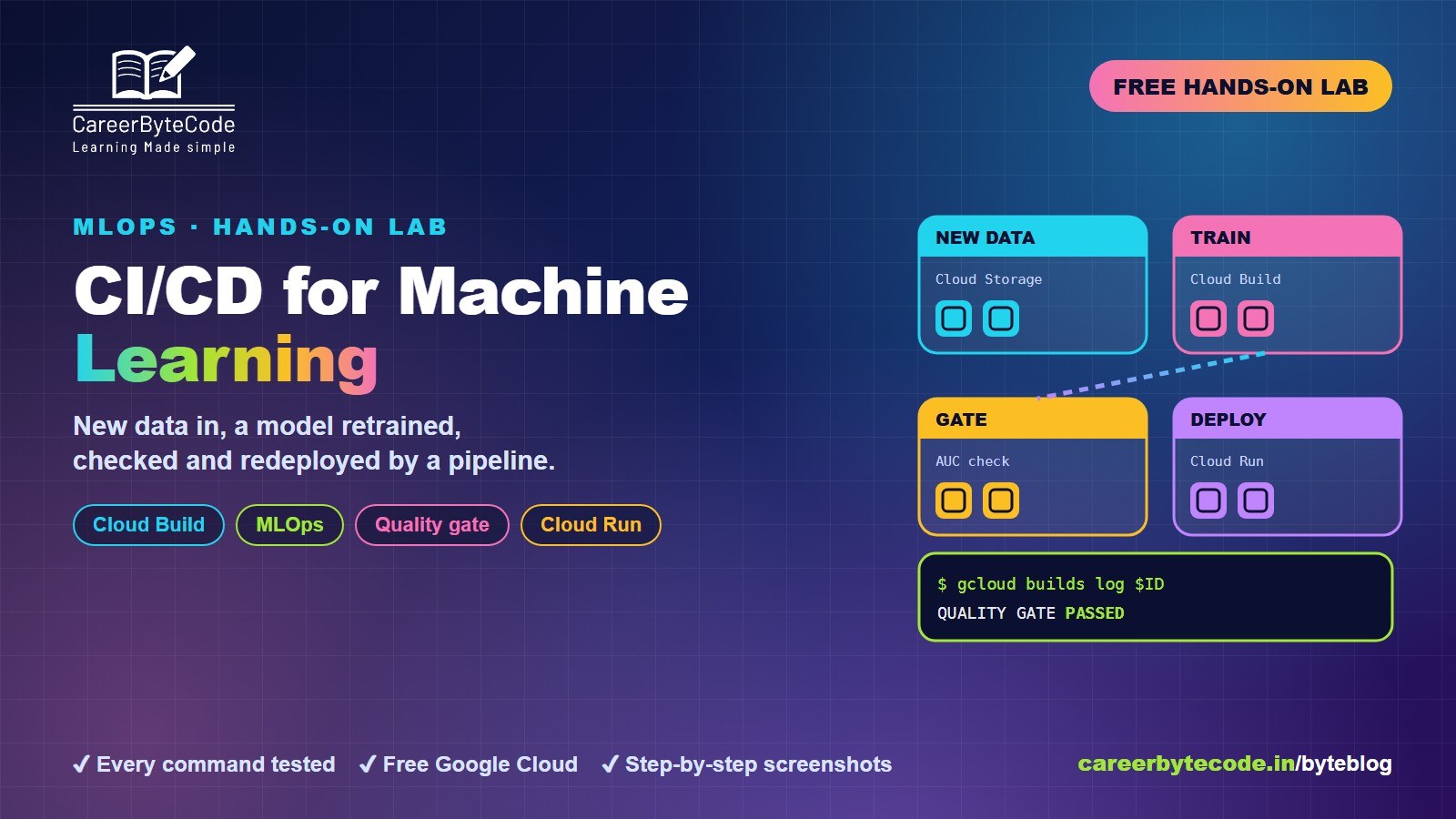 CareerByteCode Team
CI/CD for Machine Learning with Cloud Build
What you build: a Cloud Build pipeline that retrains a churn model whenever new data lands in a bucket, checks it with a quality gate and redeploys on Cloud Run; broken data is stopped automatically.
#google-cloud CareerByteCode Team
MLOps Interview Questions Answered with Labs
What you build: 6 MLOps interview answers proved with real scikit-learn experiments: leakage, reproducibility, imbalance, skew, versioning, latency. Every step tested.
#feature CareerByteCode Team
Feature Store Explained with a Real Example
What you build: Feast with real customer data: a leaky training set that scores 94 percent, the point-in-time truth, online serving and TTL. Every step tested.
💬 Comments (0)
Top · NewestSign in to comment