Most Enterprise AI Projects Do Not Fail Because of the Model
Explore CareerByteCode — Learn, Build, and Grow With a Global Tech Community
If you are building your career in AI, cloud, data, DevOps, or enterprise technology, don’t learn in isolation. CareerByteCode brings together engineers, working professionals, trainers, founders, and technology leaders to learn through practical execution, hands-on engineering, and community-led knowledge sharing.
Explore the community, join upcoming learning initiatives and events, and connect with professionals building real-world technology solutions.
Why architecture, workflow design, governance, integration, and ownership decide whether AI reaches production
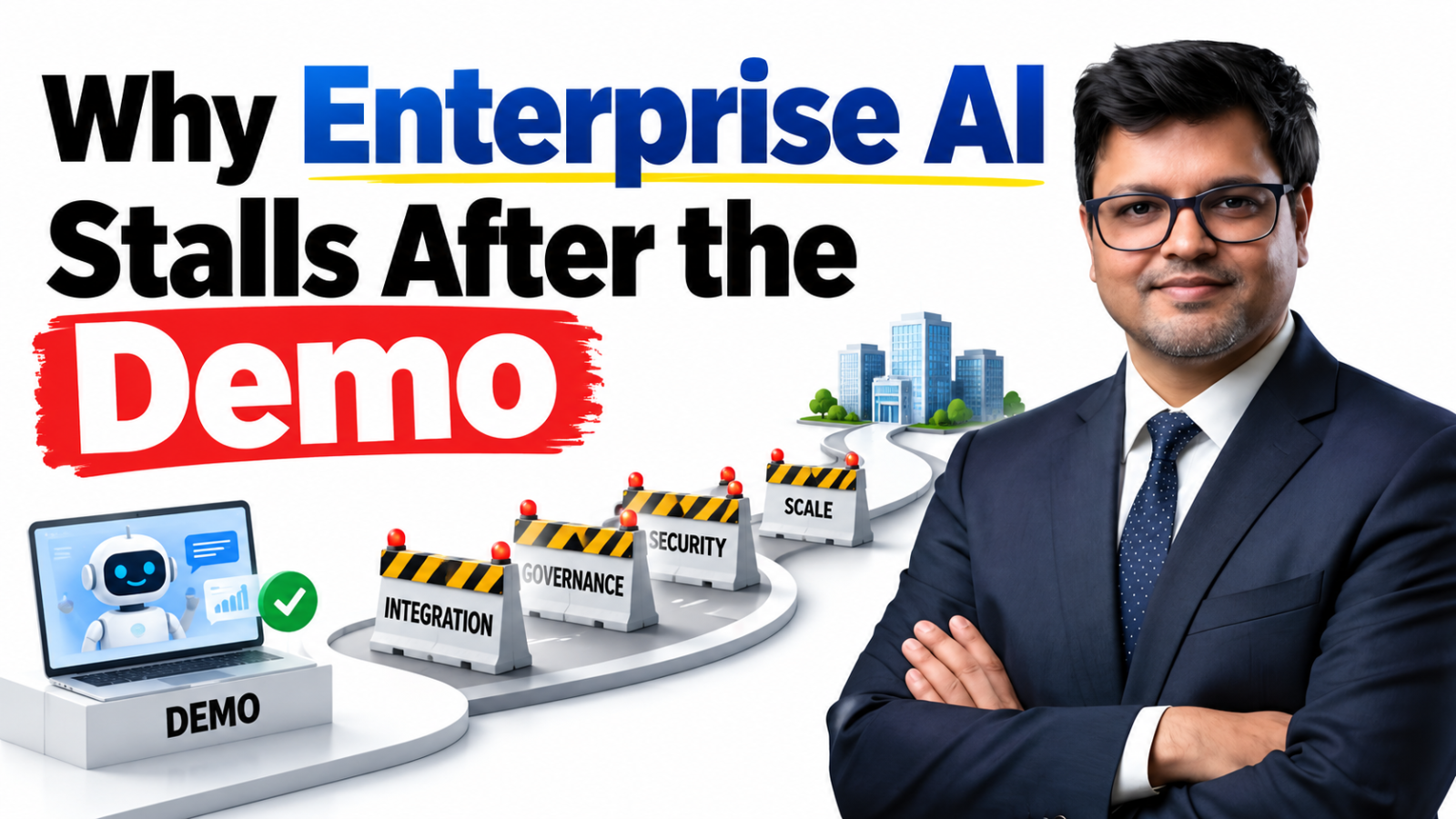
✨ From the author · BytePlay course[Beginner] Multi Agent Implementation with Microsoft Agent Framework using Microsoft Azure₹499Start learning →Most enterprise AI projects do not fail because of the model. They struggle when a promising model is placed inside a workflow that cannot supply trusted context, enforce business rules, reach the right systems, or hand a decision to the right person.
A demo can summarize a document in seconds. A production system must also establish which document version is authoritative, who may see it, what happens when it is missing, whether the response is correct, and who is accountable when the answer is used. That is a very different problem.
Executive Summary
Model selection matters. Accuracy, latency, cost, language support, and deployment constraints all affect the solution. But choosing a stronger model cannot repair a broken process or an undefined decision boundary. Enterprise value comes from the entire system around the model.
Research points in the same direction. Deloitte’s 2026 State of AI in the Enterprise reported that 30% of surveyed organizations were redesigning key processes around AI, while 37% were using AI largely at a surface level with little or no change to underlying processes. It also reported that only 21% of companies planning agentic AI deployment had a mature agent-governance model. These are survey findings, not failure-rate predictions, but they make the operating-model gap hard to ignore.¹
McKinsey’s 2026 State of AI survey found that nearly three-quarters of AI high performers had fundamentally redesigned workflows. The practical implication is not that every workflow needs an agent. It is that AI must be built into a specific way of working, with clear interfaces, controls, and responsibility for outcomes.²
This article offers a three-part lens for leaders: design the work before selecting the model; build integration and governance into the architecture; and give the business clear ownership of the result.
🛍️ Manish Kumar - Enterprise AI Architect's shelf
Courses, cohorts and more from the author
Enterprise AI Architect with 13+ Years of experience in Data Analytics , BI & AI/ML
Visit my ByteStoreFreelancer ByteStore
💬 Comments (0)
Top · NewestSign in to comment