The Future of AI Podcasting: Tools, Trends & Human Stories
Discover AI podcasting tools, emerging trends, and smarter ways to create, share, and repurpose meaningful conversations.
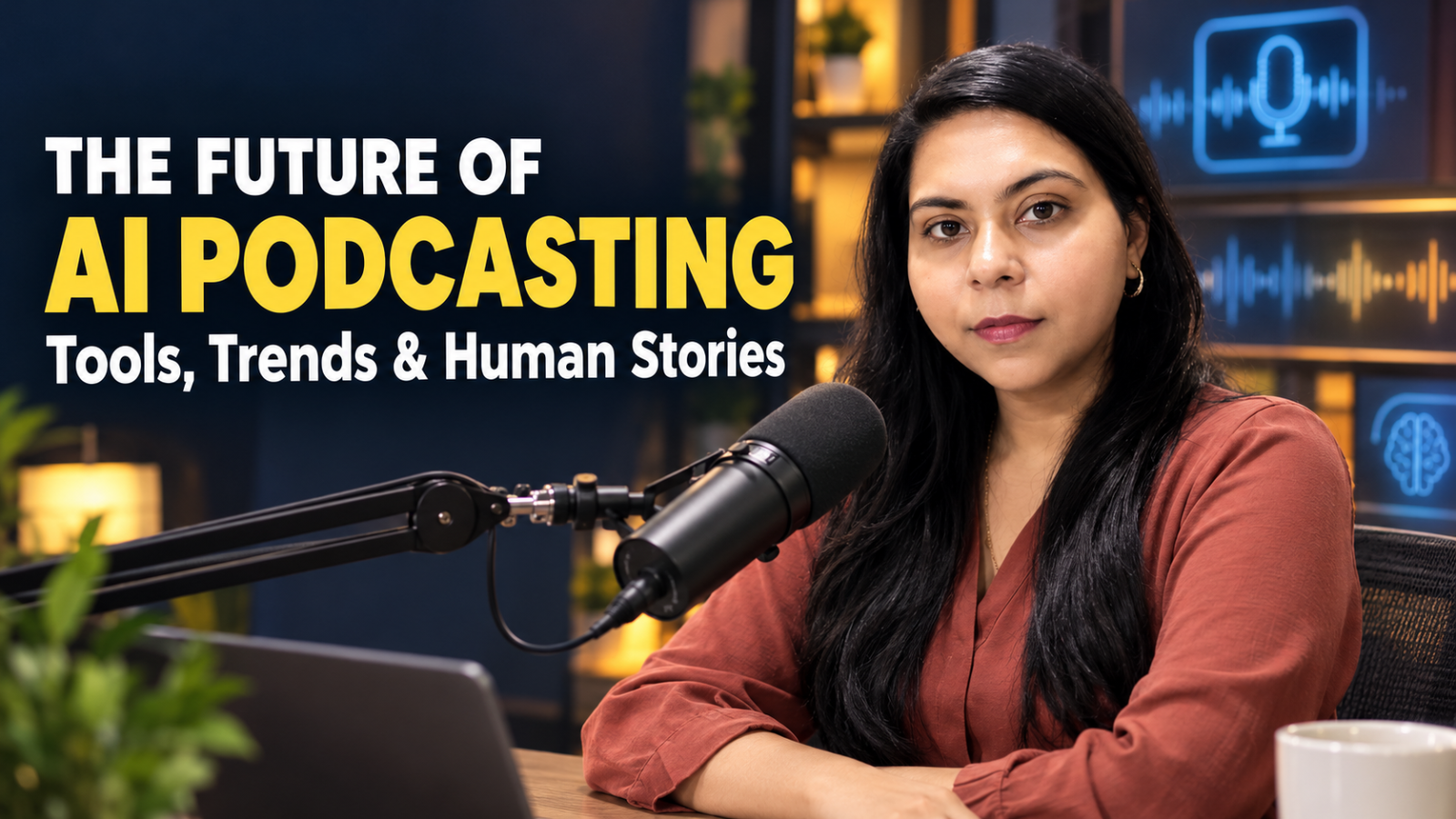
AI podcasting is changing how creators share stories, knowledge, and ideas. When I started exploring podcasting through TechRise With Viveka, what excited me most was the opportunity to connect with people, hear their stories, and learn from their experiences.
Every conversation has something valuable to offer. A technology professional might share a lesson from a challenging project. A startup founder might explain what it really takes to build a business. An AI expert might simplify a concept that many people find difficult to understand.
But I've also been thinking about something: What happens to all that valuable knowledge after a podcast episode ends?
🧑🏫✨ From the author · ByteClass live cohortAI Agents & Engineering 10 Weeks CohortFreeJoin the cohort →Can we help more people discover it? Can we make it easier to learn from it, share it, and apply it in real life?
This is where Artificial Intelligence (AI) makes podcasting particularly exciting for me.
I don't see AI as simply another technology trend. I see it as a way to help creators work smarter, make knowledge more accessible, and extend the impact of the conversations they create.
Let's explore what this could mean for the future of podcasting.
1. Helping the Right People Discover the Right Conversations
One thing I've come to appreciate about content creation is that creating something valuable and getting it in front of the right audience are two different challenges.
You could have an insightful conversation with an experienced AI engineer, an inspiring founder, or a technology leader with years of practical knowledge. But what if the people who need those insights never discover the episode?
With so much content being published every day, discovery has become a major challenge for creators and listeners alike.
AI-powered recommendation systems can help by identifying listening patterns, understanding interests, and suggesting relevant content. Instead of discovering podcasts only through popular rankings or broad categories, listeners may increasingly find conversations that match their specific questions and goals.
Imagine a student looking for a practical Generative AI roadmap or a professional trying to understand how AI agents are used in real projects. Intelligent recommendations could help them discover conversations that offer relevant guidance.
For me, this is one of the most promising possibilities: helping valuable knowledge reach beyond the people who already follow a creator.
Because creating a meaningful conversation is only the beginning. Helping the right person find it is where the real impact starts.
2. What If We Could Search a Conversation, Not Just an Episode?
Think about the last time you listened to a long interview and wanted to revisit one particular insight. You might remember what the guest discussed, but not the exact timestamp or wording.
I've often thought about how useful it would be to find that one important idea without having to replay an entire episode.
AI-powered semantic search could help make this possible.
Instead of searching only by episode title or exact keywords, listeners could potentially search for questions such as:
- Where did the guest explain how to move from an AI prototype to production?
- Which part of the conversation discusses building a technology career?
- What challenges did the founder face while launching a startup?
With searchable transcripts, timestamps, and AI-assisted summaries, podcast conversations could become easier to navigate and revisit.
I find this especially valuable for technology content. A conversation about Large Language Models, Retrieval-Augmented Generation (RAG), or Agentic AI may contain several useful explanations and practical lessons. Making those insights searchable could help listeners return to the exact information they need.
Of course, AI-generated summaries and search results must preserve the original meaning and context. The goal should be to help people find the conversation, not distort what the speaker said.
Imagine turning every podcast episode into a knowledge resource you can return to whenever you need it. That's an exciting possibility.
3. AI Podcasting Tools: From One Recording to Multiple Opportunities
Let's talk about the practical side. As a creator, I know that a podcast involves much more than sitting down for a conversation. There is planning, researching guests, preparing questions, recording, editing, writing descriptions, creating promotional content, and sharing everything across different platforms.
When you're managing multiple responsibilities, these activities can take considerable time.
This is where I see AI tools becoming useful—not as replacements for creativity, but as assistants that can reduce repetitive work.
Tools like Descript can simplify audio and video editing, while Auphonic helps improve audio quality and manage sound levels. For planning episodes, developing interview questions, and brainstorming compelling introductions, ChatGPT can serve as a useful creative assistant.
But what happens after you hit publish? That's where the opportunity gets even bigger.
Otter.ai and Sonix can help turn conversations into searchable transcripts and written content. Headliner helps creators transform podcast audio into promotional audiograms and videos, while Castmagic can help repurpose recordings into summaries, social media drafts, and other content assets.
Here's an example I find exciting. Suppose I interview an AI engineer about how AI agents are being used in real-world applications. That one conversation could become a full podcast episode, short video clips, a blog article, a list of key takeaways, and several social media posts.
Each format could help a different audience discover the same conversation.
Someone might watch a short clip on LinkedIn, another person might read the article, and someone else might listen to the complete episode while travelling.
One conversation. Multiple formats. More opportunities for people to discover and learn from it.
For me, the real advantage isn't about publishing as much content as possible. It's about making better use of the knowledge and effort already invested in creating a meaningful conversation.
AI can help with the repetitive work. The human part—choosing the right questions, understanding the guest's story, and sharing something useful—still matters enormously.
4. Reaching People Beyond Language Barriers
India has an incredibly diverse audience, with people learning, working, and communicating in different languages. A valuable conversation recorded in English may contain insights that someone else could benefit from, even if English isn't their preferred language.
This makes AI-powered translation and dubbing particularly interesting to me.
AI tools can help creators transcribe conversations, translate content, and produce dubbed versions in additional languages. These capabilities could make it easier for technology educators, industry experts, and independent creators to reach wider audiences.
Imagine a conversation with a technology leader being made accessible to listeners who prefer Hindi or another Indian language. The guest's experience could reach people who might otherwise miss the discussion.
There are important considerations, of course. Translations must preserve meaning, and creators should respect guest consent, especially when using synthetic voices or voice cloning.
Still, I believe the opportunity is significant.
Knowledge should travel further than the language in which it was first shared.
🧑🏫✨ From the author · ByteClass live cohort20-Day Personal Branding & Creator Foundation Cohort₹3,640Join the cohort →5. From Listening to Learning: Making Podcasts More Interactive
One of the possibilities I find most interesting is the idea of making podcasts more interactive.
Today, we generally listen to an episode, take away a few ideas, and move on. But what if we could explore the conversation further?
Imagine listening to an episode about Generative AI and asking for a simpler explanation of a technical term. Or listening to a discussion about RAG and requesting a summary of the key concepts, with timestamps pointing back to the relevant parts of the conversation.
AI systems powered by Large Language Models could support these experiences. When connected to reliable transcripts and supporting material through approaches such as Retrieval-Augmented Generation, they could help listeners ask questions about an episode and explore its ideas in greater depth.
For students, professionals, and anyone learning a new technology, this could make podcasts a more practical part of their learning journey.
I particularly like the idea of a listener moving from curiosity to action: hearing about a new AI concept, understanding it through an explanation, and then exploring how to apply it in a project.
Of course, AI-generated answers need to be accurate and grounded in the original conversation or reliable sources. Listeners should be able to distinguish a guest's actual statements from an AI-generated explanation.
For me, the bigger opportunity is not simply helping people consume more content. It's helping them do something meaningful with what they learn.
Don't just listen to knowledge. Explore it, question it, and find ways to apply it.
6. Why Human Connection Will Always Matter
With all these possibilities, I keep coming back to one question: what makes a podcast worth listening to in the first place?
For me, it is the people behind the conversation. A technology leader sharing a difficult career decision, a founder talking honestly about failure, or an engineer explaining a lesson learned from a challenging project can offer something that goes beyond information.
These conversations give us different perspectives. They remind us that behind every achievement are decisions, mistakes, uncertainties, and lessons that rarely appear in a polished success story.
AI can help us edit a recording, generate show notes, summarise an episode, and distribute content. But it cannot replace the importance of asking thoughtful questions, listening carefully, and creating an environment where guests feel comfortable sharing their experiences.
As AI becomes more involved in content creation, I believe trust will become even more important.
Creators need to think carefully about privacy, copyright, consent, and the responsible use of synthetic media. Guest recordings and transcripts should be handled appropriately, and AI should never be used to misrepresent someone's words or experiences.
My perspective is simple: technology should support the human story, not take it away.
My Takeaway: Create Conversations That Continue to Make an Impact
As I continue exploring the world of podcasting, I see it as an opportunity to bring people together around technology, careers, AI, innovation, and leadership.
Every guest has a different journey. Every conversation has the potential to introduce a new idea, challenge an assumption, or encourage someone to take the next step.
AI gives us more ways to extend that impact. It can help us simplify production, improve discoverability, repurpose content, reach multilingual audiences, and make conversations easier to explore.
But I don't believe success should be measured only by the number of episodes published, clips created, or views received.
I'd rather ask: Did someone discover a useful idea? Did a listener gain a new perspective? Did a conversation help someone understand a technology, explore a career opportunity, or take action on an idea?
Those are the outcomes that make content meaningful.
The future of podcasting, in my view, belongs to creators who combine intelligent tools with authentic conversations and a genuine desire to share knowledge.
Because the goal isn't just to create more content. It's to make every meaningful conversation count.
I'd love to hear your perspective
What excites you most about the future of podcasting?
- AI-powered discovery and personalised recommendations
- AI tools that simplify editing and content creation
- Multilingual podcasts that reach more people
- Interactive podcasts that support deeper learning
- The human stories and connections that technology cannot replace
Share your thoughts in the comments. I'd love to know how you think AI will change the way we create, discover, and learn from podcasts.
🛍️ Viveka Sharma's shelf
Courses, cohorts and more from the author
ABOUT ME: I’m an AI Engineer, Global AI Leader, and Technology, Career & Personal Branding Mentor, focused on Generative AI, Agentic AI, emerging technologies, and practical career growth. I mentor students and professionals on AI career transitions, practical projects, car
Visit my ByteStoreBuild Your Skills. Build Your Brand. Build Your CareerNew🌟 See Viveka Sharma's full profile: blogs, work and verified certificates
Get Viveka Sharma's next blog by email
One email a week when they publish. Add the weekly Best of ByteBlog too. No spam, unsubscribe with one click.
We email you once to confirm. By subscribing you agree to the privacy policy.
More from Viveka Sharma
 Viveka SharmaFreelancer
Will AI Replace Coders? The IT Career Shift You Can't Ignore
From Repetitive Coding to AI-Powered Problem Solving: The Rise of Forward Deployed Engineers and the Future of IT Careers
 Viveka SharmaFreelancer
JEV: The System 1 Model AI Engineers Need to Know
From Generative AI to High-Speed, Automated Decision-Making: Why JEV Matters for AI Engineers
 Viveka SharmaFreelancer
AI Is Reshaping the IT Job Market: How Professionals Can Stay Relevant
AI is changing team structures, entry-level opportunities, career expectations, and the skills professionals need to remain valuable.
 Viveka SharmaFreelancer
Stop Waiting for Students. Start Building Your Community.
Build your own visibility, create value for learners, and grow a community where trainers and learners succeed together.
💬 Comments (0)
Top · NewestSign in to comment